

3 5 8 13 Sequence
Summary: The Fibonacci Sequence is a peculiar series of numbers from classical mathematics that has found applications in advanced mathematics, nature, statistics, reckoner scientific discipline, and Agile Development. Let's delve into the origins of the sequence and how it applies to Agile Development.
What Is The Fibonacci Sequence?
The Fibonacci sequence is a serial of numbers where a number is the addition of the last two numbers, starting with 0, and 1.
The Fibonacci Sequence: 0, 1, 1, ii, iii, 5, viii, xiii, 21, 34, 55…
Written equally a dominion, the expression is:
10n = Xdue north-1 + Xdue north-2
The Active Guide To Agile Evolution
This guide provides you with a framework for how to transition your team to agile.
The Fibonacci Spiral And The Golden Ratio
The Fibonacci sequence is oft visualized in a graph such every bit the one in the header of this article. Each of the squares illustrates the area of the next number in the sequence. The Fibonacci spiral is so drawn within the squares by connecting the corners of the boxes.
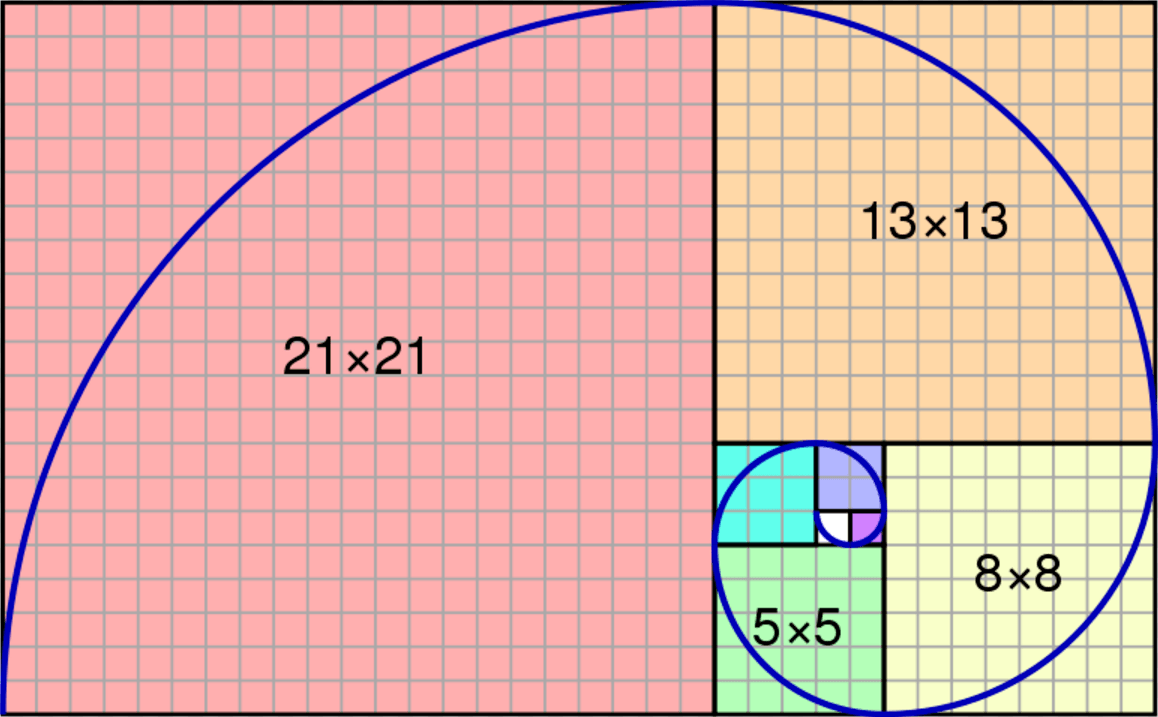
The squares fit together perfectly considering the ratio between the numbers in the Fibonacci sequence is very shut to the golden ratio [1], which is approximately 1.618034. The larger the numbers in the Fibonacci sequence, the closer the ratio is to the gold ratio.
The spiral and resulting rectangle are also known as the Golden Rectangle [2].
The Origins Of The Fibonacci Sequence
Fibbonaci (Leanardo Pisano Bogollo [three], Fibonacci was his nickname) first introduced the series of numbers known as the Fibonacci sequence in his volume Liver Abaci [4] in 1202. Fibonacci was a fellow member of an important Italian trading family in the 12th and 13th century. Being part of a trading family unit, mathematics was an integral part of the business. Fibonacci traveled throughout the Center East and India and was captivated past the mathematical ideas from his travels. His book, Liver Abaci, was a discourse on the mathematical methods in commerce that Fibonacci observed during his travels.
Fibonacci is remembered for two important contributions to Western mathematics:
- He helped spread the use of Hindu systems of writing numbers in Europe (0,i,2,three,4,v in place of Roman numerals).
- The seemingly insignificant series of numbers later on named the Fibonacci Sequence later on him.
Fibonacci discovered the sequence past posing the following question:
If a pair of rabbits is placed in an enclosed area, how many rabbits will be born there if nosotros assume that every month a pair of rabbits produces another pair and that rabbits begin to bear young 2 months after their birth?
- Beginning: At the start no rabbits are born, equally the initial pair has not had time to be pregnant and built-in (0).
- The first calendar month: Ane pair of rabbits are born (i).
- The second month: Again, one pair of rabbits are born as the new rabbits accept not yet matured to bear young (1).
- The third month: Two pairs of rabbits reproduce, and one pair is not gear up, so ii pairs of rabbits are born (ii).
- The fourth month: Three pairs of rabbits reproduce and two pairs of rabbits are non fix, and then three pairs of rabbits are born (3).
- The fifth month: Five pairs of rabbits produce and three are not ready, so five pairs of rabbits are born (5).
- And then on.
Though Fibonacci's question concerning the rabbits is an unrealistic scenario, the sequence can be observed in nature, such as in the assortment of sunflower seeds and other plants, and the shape of galaxies and hurricanes.

Sunflower Seeds are a dramatic demonstration the Fibonacci Sequence in nature.
The Importance of the Fibonacci Sequence
While this series of numbers from this simple brain teaser may seem inconsequential, it has been rediscovered in an astonishing variety of forms, from branches of advanced mathematics [5] to applications in computer science [6], statistics [seven], nature [8], and active evolution.
How Τhe Fibonacci Sequence Ιs Used Ιn Agile Development
Now you lot may be maxim to yourself "That's nice, but what does it take to do with Agile Development?", and that's a bang-up question. What does the Fibonacci Sequence have to practise with Agile Evolution?Interestingly, the Fibonacci's Sequence is a useful tool for estimating the time to complete tasks.
Estimating Tasks In Active
A large office of managing an Agile team is estimating the time tasks will have to complete. A points system is often used to give a high-level approximate of the scale or size of a specific job. Bigger more than circuitous tasks go more points and smaller tasks become fewer points. Managers can then review and prioritize tasks based upon the assigned scale.
Using The Fibonacci Sequence With Your Team
To use the Fibonacci Sequence, instruct your team to score tasks from the Fibonacci Sequence upwards to 21.
1, 2, 3, 5, 8, 13, 21
I being the smallest easiest tasks and twenty-one being large projects. Every bit far as why yous should apply the Fibonacci sequence instead of, say, t-shirt sizes, bank check dorsum for my next article on v Reasons Using the Fibonacci Sequence Volition Make You Better at Estimating Tasks in Agile Development.
And for more than on leading an Active eLearning Development team, check out our sweet eBook guide, The Agile Guide to Agile Development.
Related articles:
i. five Reasons Using The Fibonacci Sequence Makes You Better At Agile Development
2. 8 Components And Uses Of Burndown Charts In Agile Development
3. eBook: The Agile Guide To Agile Development
References
- Golden ratio
- Golden rectangle
- Leonardo Pisano Fibonacci
- Fibonacci's Liber Abaci: A Translation into Modern English language of Leonardo Pisano'south Book of Calculation (Sources and Studies in the History of Mathematics and Physical Sciences)
- Fibonacci Sequence
- Why are Fibonacci numbers pregnant in computer science?
- Fibonacci Numbers, Statistical Convergence and Applications
- Fibonacci in Nature

3 5 8 13 Sequence,
Source: https://elearningindustry.com/fibonacci-sequence-what-is-and-how-applies-agile-development
Posted by: vanhorneworidence.blogspot.com
0 Response to "3 5 8 13 Sequence"
Post a Comment