

What Is The Unit U
| dalton (unified diminutive mass unit) | |
|---|---|
| Unit of | mass |
| Symbol | Da or u |
| Named subsequently | John Dalton |
| Conversions | |
| i Da or u in ... | ... is equal to ... |
| kg | one.660539 066 60(l)×x−27 |
| m u | 1 |
| m eastward | 1822.888486 209(53) |
| MeV/c 2 | 931.494102 42(28) |
The dalton or unified atomic mass unit of measurement (symbols: Da or u) is a unit of mass widely used in physics and chemistry. It is defined as 1⁄12 of the mass of an unbound neutral atom of carbon-12 in its nuclear and electronic ground land and at remainder.[ane] [2] The atomic mass constant, denoted m u, is defined identically, giving m u = m(12C)/12 = 1 Da.[3]
This unit of measurement is commonly used in physics and chemistry to express the mass of atomic-calibration objects, such as atoms, molecules, and elementary particles, both for discrete instances and multiple types of ensemble averages. For example, an atom of helium-4 has a mass of iv.0026 Da. This is an intrinsic property of the isotope and all helium-4 atoms have the aforementioned mass. Acetylsalicylic acid (aspirin), C
9 H
8 O
4 , has an average mass of approximately 180.157 Da. Nevertheless, there are no acetylsalicylic acrid molecules with this mass. The ii nearly mutual masses of private acetylsalicylic acid molecules are 180.0423 Da, having the most common isotopes, and 181.0456 Da, in which one carbon is carbon-xiii.
The molecular masses of proteins, nucleic acids, and other large polymers are often expressed with the units kilodaltons (kDa), megadaltons (MDa), etc.[4] Titin, one of the largest known proteins, has a molecular mass of between 3 and iii.7 megadaltons.[5] The Dna of chromosome i in the human genome has about 249 one thousand thousand base of operations pairs, each with an boilerplate mass of about 650 Da, or 156 GDa total.[6]
The mole is a unit of amount of substance, widely used in chemistry and physics, which was originally divers so that the mass of one mole of a substance, measured in grams, would be numerically equal to the average mass of one of its constituent particles, measured in daltons. That is, the molar mass of a chemical compound was meant to be numerically equal to its average molecular mass. For example, the average mass of i molecule of water is nearly 18.0153 daltons, and one mole of h2o is about 18.0153 grams. A poly peptide whose molecule has an average mass of 64 kDa would have a tooth mass of 64 kg/mol. However, while this equality tin exist assumed for almost all applied purposes, it is now only guess, considering of the way mole was redefined on 20 May 2019.[4] [i]
In general, the mass in daltons of an cantlet is numerically close simply not exactly equal to the number of nucleons A independent in its nucleus. It follows that the molar mass of a compound (grams per mole) is numerically close to the average number of nucleons contained in each molecule. Past definition, the mass of an atom of carbon-12 is 12 daltons, which corresponds with the number of nucleons that it has (half-dozen protons and 6 neutrons). However, the mass of an atomic-scale object is affected by the binding energy of the nucleons in its atomic nuclei, too every bit the mass and binding free energy of its electrons. Therefore, this equality holds only for the carbon-12 atom in the stated conditions, and will vary for other substances. For example, the mass of one unbound atom of the common hydrogen isotope (hydrogen-1, protium) is 1.007825 032 241(94) Da,[a] the mass of the proton is 1.007276 466 621(53) Da,[7], the mass of one complimentary neutron is ane.008664 915 95(49) Da,[viii] and the mass of 1 hydrogen-2 (deuterium) atom is 2.014101 778 114(122) Da.[9] In full general, the deviation (accented mass excess) is less than 0.1%; exceptions include hydrogen-1 (most 0.viii%), helium-iii (0.5%), lithium-6 (0.25%) and beryllium (0.14%).
The dalton differs from the unit of measurement of mass in the atomic units systems, which is the electron rest mass (k e).
Energy equivalents [edit]
The atomic mass constant can besides exist expressed as its energy-equivalent, m u c two. The 2018 CODATA recommended values are:
m u c ii = 1.492418 085 60(45)×10−10 J [10] = 931.494102 42(28) MeV [11]
The megaelectronvolt mass-equivalent (MeV/c 2) is normally used as a unit of measurement of mass in particle physics, and these values are also important for the applied determination of relative atomic masses.
History [edit]
Origin of the concept [edit]

The interpretation of the constabulary of definite proportions in terms of the atomic theory of matter unsaid that the masses of atoms of various elements had definite ratios that depended on the elements. While the bodily masses were unknown, the relative masses could exist deduced from that police. In 1803 John Dalton proposed to use the (still unknown) diminutive mass of the lightest cantlet, that of hydrogen, as the natural unit of atomic mass. This was the basis of the atomic weight calibration.[12]
For technical reasons, in 1898, chemist Wilhelm Ostwald and others proposed to redefine the unit of measurement of diminutive mass as 1⁄sixteen of the mass of an oxygen atom.[13] That proposal was formally adopted by the International Committee on Diminutive Weights (ICAW) in 1903. That was approximately the mass of one hydrogen atom, merely oxygen was more amenable to experimental determination. This suggestion was fabricated earlier the discovery of the existence of elemental isotopes, which occurred in 1912.[12] The physicist Jean Perrin had adopted the same definition in 1909 during his experiments to determine the atomic masses and the Avogadro constant.[14] This definition remained unchanged until 1961.[15] [sixteen] Perrin also defined the "mole" as an corporeality of a chemical compound that contained as many molecules every bit 32 grams of oxygen (O
2 ). He called that number the Avogadro number in honor of physicist Amedeo Avogadro.
Isotopic variation [edit]
The discovery of isotopes of oxygen in 1929 required a more precise definition of the unit. Unfortunately, 2 singled-out definitions came into utilize. Chemists choose to define the AMU every bit 1⁄16 of the average mass of an oxygen atom as constitute in nature; that is, the average of the masses of the known isotopes, weighted by their natural affluence. Physicists, on the other mitt, defined it as 1⁄16 of the mass of an atom of the isotope oxygen-16 (16O).[xiii]
Definition by the IUPAC [edit]
The existence of ii distinct units with the same name was confusing, and the difference (near 1.000282 in relative terms) was large plenty to touch on loftier-precision measurements. Moreover, it was discovered that the isotopes of oxygen had different natural abundances in water and in air. For these and other reasons, in 1961 the International Spousal relationship of Pure and Applied Chemistry (IUPAC), which had absorbed the ICAW, adopted a new definition of the atomic mass unit for apply in both physics and chemistry; namely, 1⁄12 of the mass of a carbon-12 atom. This new value was intermediate between the ii earlier definitions, but closer to the one used by chemists (who would be affected the virtually by the modify).[12] [13]
The new unit of measurement was named the "unified diminutive mass unit" and given a new symbol "u", to replace the old "amu" that had been used for the oxygen-based units.[17] However, the old symbol "amu" has sometimes been used, after 1961, to refer to the new unit, especially in lay and preparatory contexts.
With this new definition, the standard atomic weight of carbon is approximately 12.011 Da, and that of oxygen is approximately 15.999 Da. These values, generally used in chemistry, are based on averages of many samples from Earth's chaff, its atmosphere, and organic materials.
Adoption by the BIPM [edit]
The IUPAC 1961 definition of the unified atomic mass unit, with that proper noun and symbol "u", was adopted by the International Bureau for Weights and Measures (BIPM) in 1971 as a non-SI unit of measurement accepted for use with the SI.[xviii]
Unit name [edit]
In 1993, the IUPAC proposed the shorter name "dalton" (with symbol "Da") for the unified diminutive mass unit.[nineteen] [20] As with other unit names such equally watt and newton, "dalton" is not capitalized in English, but its symbol, "Da", is capitalized. The name was endorsed by the International Union of Pure and Applied Physics (IUPAP) in 2005.[21]
In 2003 the name was recommended to the BIPM by the Consultative Commission for Units, part of the CIPM, as it "is shorter and works better with [the SI] prefixes".[22] In 2006, the BIPM included the dalton in its 8th edition of the formal definition of SI.[23] The name was also listed equally an alternative to "unified atomic mass unit" by the International Organization for Standardization in 2009.[24] [25] It is now recommended by several scientific publishers,[26] and some of them consider "diminutive mass unit" and "amu" deprecated.[27] In 2019, the BIPM retained the dalton in its 9th edition of the formal definition of SI while dropping the unified atomic mass unit from its table of non-SI units accustomed for use with the SI, just secondarily notes that the dalton (Da) and the unified diminutive mass unit (u) are alternative names (and symbols) for the same unit.[one]
2019 redefinition of the SI base units [edit]
The definition of the dalton was non affected by the 2019 redefinition of SI base units,[28] [29] [one] that is, 1 Da in the SI is nonetheless ane⁄12 of the mass of a carbon-12 atom, a quantity that must be determined experimentally in terms of SI units. Even so, the definition of a mole was changed to exist the amount of substance consisting of exactly 6.022140 76 ×1023 entities and the definition of the kilogram was changed also. Every bit a consequence, the tooth mass abiding is no longer exactly 1 1000/mol, significant that the number of grams in the mass of ane mole of whatever substance is no longer exactly equal to the number of daltons in its boilerplate molecular mass.[30]
Measurement [edit]
Although relative atomic masses are defined for neutral atoms, they are measured (by mass spectrometry) for ions: hence, the measured values must be corrected for the mass of the electrons that were removed to grade the ions, and also for the mass equivalent of the electron binding free energy, E b/m u c ii. The total binding free energy of the 6 electrons in a carbon-12 atom is 1030.1089 eV = 1.6504163 ×x−sixteen J: East b/one thousand u c 2 = 1.1058674 ×ten−6 , or about one part in 10 million of the mass of the atom.[31]
Before the 2019 redefinition of SI units, experiments were aimed to determine the value of the Avogadro abiding for finding the value of the unified atomic mass unit.
Josef Loschmidt [edit]
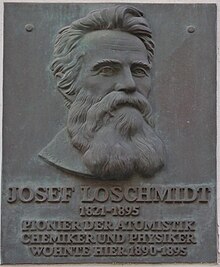
A reasonably accurate value of the atomic mass unit was beginning obtained indirectly by Josef Loschmidt in 1865, by estimating the number of particles in a given volume of gas.[32]
Jean Perrin [edit]
Perrin estimated the Avogadro number past a variety of methods, at the turn of the 20th century. He was awarded the 1926 Nobel Prize in Physics, largely for this work.[33]
Coulometry [edit]
The electrical accuse per mole of elementary charges is a constant called the Faraday abiding, F, whose value had been essentially known since 1834 when Michael Faraday published his works on electrolysis. In 1910, Robert Millikan obtained the first measurement of the accuse on an electron, −eastward. The quotient F/east provided an judge of the Avogadro constant.[34]
The classic experiment is that of Bower and Davis at NIST,[35] and relies on dissolving silverish metal away from the anode of an electrolysis jail cell, while passing a constant electric electric current I for a known fourth dimension t. If g is the mass of silver lost from the anode and A r the diminutive weight of silver, then the Faraday constant is given past:

The NIST scientists devised a method to compensate for silver lost from the anode by mechanical causes, and conducted an isotope analysis of the silverish used to make up one's mind its atomic weight. Their value for the conventional Faraday constant was F 90 = 96485.39(xiii) C/mol, which corresponds to a value for the Avogadro constant of 6.0221449(78)×ten23 mol−1 : both values have a relative standard doubtfulness of 1.iii×10−6 .
Electron mass measurement [edit]
In exercise, the atomic mass abiding is determined from the electron balance mass thou e and the electron relative atomic mass A r(e) (that is, the mass of electron divided by the atomic mass abiding).[36] The relative atomic mass of the electron can be measured in cyclotron experiments, while the rest mass of the electron tin be derived from other concrete constants.
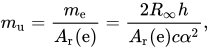


where c is the speed of calorie-free, h is the Planck constant, α is the fine-structure abiding, and R ∞ is the Rydberg constant.
As may be observed from the erstwhile values (2014 CODATA) in the table below, the main limiting cistron in the precision of the Avogadro abiding was the uncertainty in the value of the Planck constant, as all the other constants that contribute to the calculation were known more than precisely.
| Constant | Symbol | 2014 CODATA values | Relative standard doubtfulness | Correlation coefficient with Due north A |
|---|---|---|---|---|
| Proton–electron mass ratio | m p/m e | 1836.152673 89(17) | 9.5×10−eleven | −0.0003 |
| Molar mass constant | Thousand u | 0.001 kg/mol = 1 chiliad/mol | 0 (defined) | — |
| Rydberg abiding | R ∞ | 10973 731.568508(65) m−1 | 5.9×10⁻¹² | −0.0002 |
| Planck constant | h | six.626070 040(81)×10−34 J⋅s | i.ii×10−eight | −0.9993 |
| Speed of low-cal | c | 299792 458 thousand/southward | 0 (divers) | — |
| Fine construction constant | α | vii.297352 5664(17)×10−3 | 2.3×10⁻¹⁰ | 0.0193 |
| Avogadro constant | Northward A | 6.022140 857(74)×1023 mol−i | 1.two×10−eight | ane |
The power of the presently divers values of universal constants can be understood from the table below (2018 CODATA).
| Constant | Symbol | 2018 CODATA values[37] | Relative standard dubiety | Correlation coefficient with Due north A |
|---|---|---|---|---|
| Proton–electron mass ratio | m p/yard e | 1836.152673 43(11) | 6.0×10⁻¹¹ | — |
| Molar mass constant | M u | 0.999999 999 65(30)×x−3 kg/mol | 3.0×10⁻¹⁰ | — |
| Rydberg abiding | R ∞ | 10973 731.568160(21) m−1 | 1.ix×ten−12 | — |
| Planck constant | h | 6.626070 fifteen ×x−34 J⋅s | 0 (defined) | — |
| Speed of light | c | 299792 458 g/s | 0 (defined) | — |
| Fine structure abiding | α | vii.297352 5693(11)×10−3 | 1.5×x−x | — |
| Avogadro constant | North A | 6.022140 76 ×1023 mol−i | 0 (defined) | — |
X-ray crystal density methods [edit]

Silicon single crystals may be produced today in commercial facilities with extremely high purity and with few lattice defects. This method divers the Avogadro constant every bit the ratio of the molar book, 5 thousand, to the atomic volume 5 atom:
,
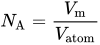
where
- , and
- north is the number of atoms per unit cell of volume V jail cell.
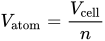
The unit cell of silicon has a cubic packing organization of 8 atoms, and the unit cell volume may be measured past determining a unmarried unit prison cell parameter, the length a of one of the sides of the cube.[38] The 2018 CODATA value of a for silicon is five.431020 511(89)×10−10 m.[39]
In do, measurements are carried out on a distance known every bit d 220(Si), which is the altitude between the planes denoted by the Miller indices {220}, and is equal to a/√eight .
The isotope proportional composition of the sample used must be measured and taken into business relationship. Silicon occurs in three stable isotopes (28Si, 29Si, thirtySi), and the natural variation in their proportions is greater than other uncertainties in the measurements. The diminutive weight A r for the sample crystal can be calculated, equally the standard atomic weights of the three nuclides are known with great accuracy. This, together with the measured density ρ of the sample, allows the tooth book V m to be determined:
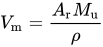
where Thousand u is the molar mass constant. The 2018 CODATA value for the molar volume of silicon is 1.205883 199(60)×10−v m3⋅mol−1 , with a relative standard doubt of iv.ix×10−8 .[40]
Run across also [edit]
- Mass (mass spectrometry)
- Kendrick mass
- Monoisotopic mass
- Mass-to-charge ratio
Notes [edit]
- ^ The digits in parentheses point the doubt; run into Uncertainty notation.
References [edit]
- ^ a b c d Bureau International des Poids et Mesures (2019): The International Organization of Units (SI), 9th edition, English version, page 146. Available at the BIPM website.
- ^ IUPAC, Compendium of Chemical Terminology, 2nd ed. (the "Gold Book") (1997). Online corrected version: (2006–) "diminutive mass constant". doi:x.1351/goldbook.A00497
- ^ Barry North Taylor (2009). "Molar mass and related quantities in the New SI". Metrologia. 46 (three): L16–L19. doi:10.1088/0026-1394/46/3/L01. S2CID 115540416.
- ^ a b Berg, Jeremy M.; Tymoczko, John Fifty.; Stryer, Lubert (2007). "2". Biochemistry (sixth ed.). p. 35. ISBN978-0-7167-8724-2.
- ^ Opitz CA, Kulke 1000, Leake MC, Neagoe C, Hinssen H, Hajjar RJ, Linke WA (October 2003). "Damped rubberband recoil of the titin spring in myofibrils of human myocardium". Proc. Natl. Acad. Sci. U.Due south.A. 100 (22): 12688–93. Bibcode:2003PNAS..10012688O. doi:10.1073/pnas.2133733100. PMC240679. PMID 14563922.
- ^ Integrated Deoxyribonucleic acid Technologies (2011): "Molecular Facts and Figures Archived 2020-04-18 at the Wayback Machine". Article on the IDT website, Back up & Education section Archived 2021-01-nineteen at the Wayback Car, accessed on 2019-07-08.
- ^ "2018 CODATA Value: proton mass in u". The NIST Reference on Constants, Units, and Doubtfulness. NIST. 20 May 2019. Retrieved 2022-09-11 .
- ^ "2018 CODATA Value: neutron mass in u". The NIST Reference on Constants, Units, and Dubiety. NIST. twenty May 2019. Retrieved 2020-06-24 .
- ^ Meng Wang, Thou. Audi, F.G. Kondev, W.J. Huang, Due south. Naimi, and Xing Xu (2017): "The Ame2016 atomic mass evaluation (II). Tables, graphs and references". Chinese Physics C, volume 41, issue 3, commodity 030003, pages i-441. doi:10.1088/1674-1137/41/iii/030003
- ^ "2018 CODATA Value: atomic mass constant energy equivalent". The NIST Reference on Constants, Units, and Dubiousness. NIST. 20 May 2019. Retrieved 2019-07-21 .
- ^ "2018 CODATA Value: diminutive mass constant energy equivalent in MeV". The NIST Reference on Constants, Units, and Uncertainty. NIST. xx May 2019. Retrieved 2019-07-21 .
- ^ a b c Petley, B. W. (1989). "The atomic mass unit of measurement". IEEE Trans. Instrum. Meas. 38 (2): 175–179. doi:10.1109/19.192268.
- ^ a b c Holden, Norman E. (2004). "Atomic Weights and the International Committee—A Historical Review". Chemistry International. 26 (ane): four–seven.
- ^ Perrin, Jean (1909). "Mouvement brownien et réalité moléculaire". Annales de Chimie et de Physique. 8e Série. 18: 1–114. Extract in English, translation by Frederick Soddy.
- ^ Chang, Raymond (2005). Concrete Chemistry for the Biosciences. p. five. ISBN978-i-891389-33-vii.
- ^ Kelter, Paul B.; Mosher, Michael D.; Scott, Andrew (2008). Chemistry: The Practical Science. Vol. x. p. 60. ISBN978-0-547-05393-6.
- ^ IUPAC, Compendium of Chemical Terminology, second ed. (the "Gold Volume") (1997). Online corrected version: (2006–) "unified atomic mass unit of measurement". doi:x.1351/goldbook.U06554
- ^ Agency International des Poids et Mesures (1971): 14th Conference Générale des Poids et Mesures Archived 2020-09-23 at the Wayback Motorcar Available at the BIPM website.
- ^ Mills, Ian; Cvitaš, Tomislav; Homann, Klaus; Kallay, Nikola; Kuchitsu, Kozo (1993). Quantities, Units and Symbols in Physical Chemistry International Spousal relationship of Pure and Practical Chemistry; Physical Chemistry Division (2nd ed.). International Spousal relationship of Pure and Applied Chemical science and published for them by Blackwell Science Ltd. ISBN978-0-632-03583-0.
- ^ IUPAC, Compendium of Chemical Terminology, 2nd ed. (the "Gold Book") (1997). Online corrected version: (2006–) "dalton". doi:10.1351/goldbook.D01514
- ^ "IUPAP: C2: Report 2005". Retrieved 2018-07-15 .
- ^ "Consultative Committee for Units (CCU); Report of the 15th meeting (17–18 April 2003) to the International Commission for Weights and Measures" (PDF) . Retrieved fourteen Aug 2010.
- ^ International Bureau of Weights and Measures (2006), The International System of Units (SI) (PDF) (8th ed.), pp. 114–15, ISBN92-822-2213-6, archived (PDF) from the original on 2021-06-04, retrieved 2021-12-16
- ^ International Standard ISO 80000-ane:2009 – Quantities and Units – Part ane: General. International Organization for Standardization. 2009.
- ^ International Standard ISO 80000-x:2009 – Quantities and units – Part ten: Diminutive and nuclear physics, International Arrangement for Standardization, 2009
- ^ "Instructions to Authors". AoB Plants. Oxford journals; Oxford University Press. Archived from the original on 2011-11-03. Retrieved 2010-08-22 .
- ^ "Author guidelines". Rapid Communications in Mass Spectrometry. Wiley-Blackwell. 2010.
- ^ International Agency for Weights and Measures (2017): Proceedings of the 106th meeting of the International Committee for Weights and Measures (CIPM), 16-17 and 20 October 2017, page 23. Available at the BIPM website Archived 2021-02-21 at the Wayback Machine.
- ^ International Bureau for Weights and Measures (2018): Resolutions Adopted - 26th Conference Générale des Poids et Mesures Archived 2018-eleven-xix at the Wayback Machine. Available at the BIPM website.
- ^ Lehmann, H. P.; Fuentes-Arderiu, X.; Bertello, L. F. (2016-02-29). "Unified Atomic Mass Unit of measurement". doi:10.1515/iupac.68.2930.
- ^ Mohr, Peter J.; Taylor, Barry N. (2005). "CODATA recommended values of the central concrete constants: 2002" (PDF). Reviews of Modern Physics. 77 (1): one–107. Bibcode:2005RvMP...77....1M. doi:10.1103/RevModPhys.77.1. Archived from the original (PDF) on 2017-10-01.
- ^ Loschmidt, J. (1865). "Zur Grösse der Luftmoleküle". Sitzungsberichte der Kaiserlichen Akademie der Wissenschaften Wien. 52 (2): 395–413. English translation.
- ^ Oseen, C.W. (December 10, 1926). Presentation Speech for the 1926 Nobel Prize in Physics.
- ^ (1974): Introduction to the constants for nonexperts, 1900–1920 From the Encyclopaedia Britannica, 15th edition; reproduced by NIST. Accessed on 2019-07-03.
- ^ This account is based on the review in Mohr, Peter J.; Taylor, Barry N. (1999). "CODATA recommended values of the central physical constants: 1998" (PDF). Journal of Physical and Chemical Reference Information. 28 (6): 1713–1852. Bibcode:1999JPCRD..28.1713M. doi:10.1063/1.556049. Archived from the original (PDF) on 2017-10-01.
- ^ Mohr, Peter J.; Taylor, Barry N. (1999). "CODATA recommended values of the key physical constants: 1998" (PDF). Journal of Concrete and Chemic Reference Data. 28 (half dozen): 1713–1852. Bibcode:1999JPCRD..28.1713M. doi:ten.1063/1.556049. Archived from the original (PDF) on 2017-ten-01.
- ^ "Constants bibliography, source of the CODATA internationally recommended values". The NIST Reference on Constants, Units, and Uncertainty . Retrieved 4 August 2021.
- ^ "Unit Prison cell Formula". Mineralogy Database. 2000–2005. Retrieved 2007-12-09 .
- ^ "2018 CODATA Value: lattice parameter of silicon". The NIST Reference on Constants, Units, and Uncertainty. NIST. 20 May 2019. Retrieved 2019-08-23 .
- ^ "2018 CODATA Value: molar volume of silicon". The NIST Reference on Constants, Units, and Uncertainty. NIST. xx May 2019. Retrieved 2019-08-23 .
External links [edit]
- Atomic weights and isotopic compositions
- atomic mass unit of measurement at sizes.com

What Is The Unit U,
Source: https://en.wikipedia.org/wiki/Dalton_(unit)
Posted by: vanhorneworidence.blogspot.com
0 Response to "What Is The Unit U"
Post a Comment